Jan 25
2026
When AI Becomes the First Place Patients Turn: How Search Is Quietly Changing Dental Practice Discovery
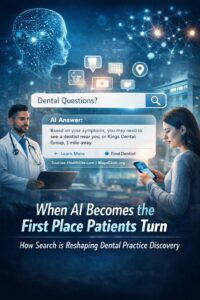 For years, patient discovery in dentistry followed a familiar path. Someone searched Google for “dentist near me,” skimmed a handful of websites, glanced at reviews, and eventually booked an appointment.
That model is no longer the only, or even the primary, way patients find care.
Increasingly, prospective dental patients are asking artificial intelligence systems the questions they once asked search engines. They are doing this through tools like ChatGPT and Perplexity, as well as through AI-enhanced summaries embedded directly into Google search results.
This shift is measurable, accelerating, and already reshaping how dental practices are discovered, interpreted, and chosen.
Patients Are Consulting AI, Not Just Searching
Dental questions are uniquely suited to conversational search. Patients want to know not just who a dentist is but what they should do about a symptom right now.
Rather than short keyword searches, today’s queries are full, contextual questions like:
- “Is a cracked tooth an emergency?”
- “Should I see an oral surgeon or general dentist for wisdom tooth pain?”
- “What causes dental abscess swelling?”
These are conversational by nature. AI systems are designed to answer them directly, not just link to a list of websites.
And this matters because dental patients almost always start online.
Multiple industry reports indicate that 71–77% of prospective dental patients research dentists online before booking an appointment.
That positions search — and increasingly AI search — as the true front door to patient acquisition.
Google Is Still Central, but Click Behavior Has Changed
Google remains the dominant gateway for dental discovery. It’s where most online journeys begin.
But how patients interact with Google results is changing. AI-generated summaries now appear at the top of many search result pages, often resolving a question before a user ever scrolls further.
Even without AI interacting directly in third-party tools, data consistently shows that the majority of dental patient journeys begin with search. In many reports:
- 77% of patients use search engines prior to booking an appointment with a dental provider.
- 78% of dental patients find their provider online overall.
- 69–71% search online before booking an appointment, and 86% contact a dentist after searching.
These behaviors underscore a simple reality: visibility matters before intent turns into action.
AI summaries amplify that effect. Instead of clicking links, patients may think the answer is “done” once they get a satisfactory response. That means the moment of visibility is shifting upstream — before any visit, page view, or click.
Zero-Click Search Is Becoming More Common
Even outside AI-generated summaries, “zero-click” behavior is increasing in search overall. Patients may get what they need from the SERP itself — whether a business profile, review snippet, or quick answer — and take action without ever visiting a website.
This trend matters for dentistry because:
- Mobile search drives appointment bookings — one study found that 44% of patients who find dentists via mobile search proceed to book appointments directly, highlighting the high intent embedded in search behavior.
- Patients expect digital convenience, including online booking and mobile-friendly experiences.
As AI becomes more integrated into search, this form of zero-click decision making will only grow.
How AI Interprets Dental Practices
AI systems like ChatGPT and AI summaries in search do more than provide links. They synthesize information from practice websites, directories, review aggregators, and structured metadata.
That synthesis is powerful, but it has limitations:
- If a dental practice’s services are not clearly defined, AI may misinterpret or omit them.
- Inconsistent listings and outdated information can dilute confidence and lower the chances a practice is recommended.
- Even accurate information may be compressed into a few lines that don’t fully convey quality or specialty capabilities.
This matters because patients trust quick answers when they feel credible. In health information contexts, studies have shown that conversational AI can be more trusted than traditional search for health queries.
In practical terms, this means that how a dental practice appears in synthesized answers can influence not just visibility but patient expectations and choices.
What This Means for Independent Dental Practices
For local dental offices, this shift changes not just how patients find them, but when they decide.
Many independent practices report:
- fewer exploratory website visits
- more appointment-ready inquiries
- patient assumptions formed before direct contact
Search behavior data supports these trends. Reports indicate that 78% of patients find their provider online, and 70% prefer online appointment scheduling to calling the office.
When patients form assumptions about services, hours, or insurance acceptance before contacting a practice, the first impression becomes a combination of:
- how clearly the practice information is written
- how well it matches patient intent
- how reviews and reputation are presented
AI influences each of those variables.
What This Means for Group and Multi-Location Practices
For dental groups and multi-location practices, the implications are even more nuanced.
AI systems do not treat a dental brand monolithically. Instead, they evaluate each location, specialty, and service independently.
If practices have inconsistent service descriptions or outdated local listings, AI confidence falls. That means:
- visibility for specific specialties (like implants or orthodontics) may vary by location
- patients may never see certain locations in AI summaries
- digital reputation signals differ by platform and practice profile
This can mask real competitive disadvantages until it shows up in appointment flow or call quality.
AI Search Is a Patient Access Issue in Dentistry
This reframing is important.
AI-mediated discovery is not just a marketing challenge. It is a patient access issue.
AI can shape dental care pathways long before a patient ever steps into the office. By influencing whether a patient seeks care, when they act, where they go, and how urgently they perceive their need, AI-driven answers effectively guide the patient journey from the very first query.
This is especially relevant in dentistry, where delays in care can escalate into more complex, costly treatments.
Accuracy and clarity are not optional. They affect patient outcomes.
Rethinking Visibility and Measurement
Legacy metrics — website traffic, keyword rankings, and organic position — are no longer sufficient on their own.
Search behavior research consistently shows:
- Search engines remain the starting point for patients — 77–80% use search before booking appointments.
- Conversion rates from search are high — with 86% contacting a dental provider after searching and a substantial share of mobile searchers booking appointments.
But influence increasingly happens before a click. It happens within summaries, conversational answers, business profiles, and snippets that satisfy intent without driving site visits.
The Questions Dental Leaders Should Be Asking
If AI becomes a default step in dental care discovery, practice leaders should be asking:
- Can AI systems clearly understand and explain what we do?
- Can they distinguish our services, specialties, locations, and access policies?
- Are our patient reviews visible and accurate across platforms?
If a patient asked an AI assistant about our practice today, would the answer reflect who we actually are?
These questions are not speculative. They are part of how patients make choices today.
A Quiet but Lasting Shift in Dental Discovery
AI is not replacing search. Even AI-enhanced search is still built on the foundations of Google, reviews, local listings, and website content.
But the path from question to decision is shorter, more conversational, and increasingly mediated by AI.
Patients may still search. Google still matters. Websites still matter.
But if AI answers the question — and answers it well — patients act, often without ever leaving the AI interface or search page.
For dental practices, success will depend less on chasing algorithms and more on being clearly understood.
Because when patients trust the answer they receive, they stop searching — and they act.